
Washington Hall
History of Washington Hall
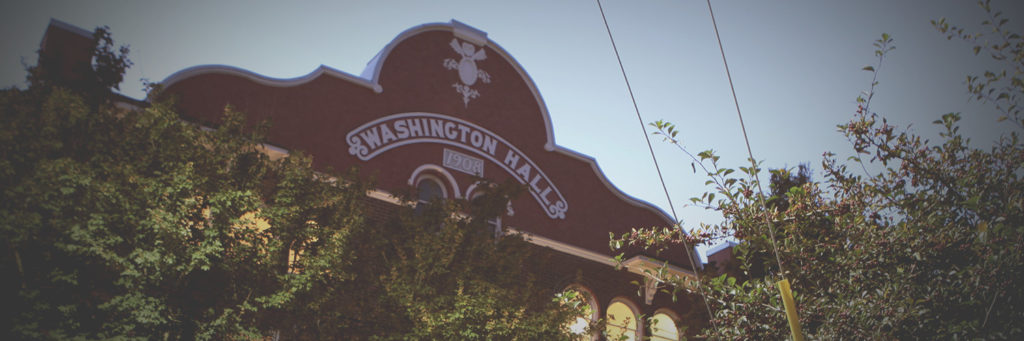
Built in 1908, Washington Hall has anchored Seattle’s Central District for over a century, from a Danish immigrant fraternal lodge to one of the city’s most storied performing arts venues.
Overview
A century of community and culture
In 1908, the Danish Brotherhood opened a spare yet proud brick-faced building in Seattle’s Central District and named it Washington Hall. Their hope was to provide boarding facilities to newly arrived Danish immigrants, yet they also declared the building a dance hall and performing arts venue for all, opening the doors of the Hall to the whole community.
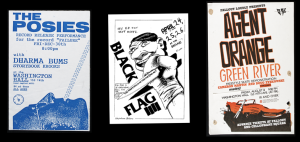
Duke Ellington, Billie Holiday, Jimi Hendrix, Mark Morris, Pat Graney, Bill T. Jones, David Byrne, Fugazi, Elvis Costello, Macklemore, and countless other musicians, artists, and great minds alike have walked these halls.
Timeline
Key moments
1908
Built by the Danish Brotherhood in America, Seattle Lodge #29, designed by architect Victor Voorhees and built by Hans Pederson, as a fraternal lodge and dance hall.
1910s
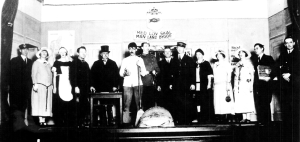
The stage at Washington Hall is in constant demand from the start, hosting Danish and Yiddish theatrical productions for the community.
1918
A NAACP benefit show at Washington Hall features Miss Lillian Smith’s Jazz Band, the first documented jazz band to perform in Seattle. Architect Andrew Willatsen also carries out alterations to the building this same year.
1930s – 1950s
The Hall keeps finding new uses, from Filipino Youth Club dances in the 1930s to boxing matches in the 1950s.
1973
The Sons of Haiti, an African-American Masonic Lodge, purchase the building and continue the tradition of hosting performing arts, making it the first home of On the Boards, which would go on to stage contemporary works at the Hall for the next 20 years.
1980s
In 1987, On the Boards presents the rap musical “Boys Will B-Boys” at Washington Hall, directed by Steve Sneed with Seattle hip-hop pioneers the Emerald Street Boys serving as consultants — an early thread connecting Washington Hall directly to Seattle’s hip-hop history.
1990s
Nu Black Arts West Theatre manages the space through the 1990s, continuing Washington Hall’s role as a stage for community theater and original works.
2009
Historic Seattle acquires Washington Hall, saving it from demolition. The renovation of Washington Hall became a Historic Seattle community development project, in collaboration with 206 Zulu, Hidmo, and Voices Rising, helping to revitalize the neighborhood and make the building available for public use.
2016
After a multi-year capital campaign and a four-phase renovation process, the building reopens to the public.
Today
Washington Hall continues as a home for arts, media, and social justice organizations, carrying on a legacy of over 115 years.
Historic details
Building record
Date built
1908
Original owner
Danish Brotherhood in America, Seattle Lodge #29
Architect / builder
Victor Voorhees (architect) / Hans Pederson (builder); Andrew Willatsen (architect for 1918 alterations)
Style
Early 20th century fraternal lodge and dance hall. Eclectic architectural style with Mission Revival elements.
Watch